

Who Is The Guy With "Eye Makeup" In The Uriah Heep Video
| Uriah Heep | |
|---|---|
 Uriah Heep performing live in 2015 | |
| Background data | |
| Origin | London, England |
| Genres |
|
| Years agile | 1969–nowadays |
| Labels |
|
| Members | Mick Box Phil Lanzon Bernie Shaw Russell Gilbrook Dave Rimmer |
| Past members | List of Uriah Heep members |
| Website | www |
Uriah Heep are an English language rock band formed in London in 1969. Their current lineup consists of lead and rhythm guitarist Mick Box, keyboardist Phil Lanzon, lead vocaliser Bernie Shaw, drummer Russell Gilbrook, and bassist Dave Rimmer. They have experienced numerous lineup changes throughout their 53-twelvemonth career, leaving Box as the simply remaining original member. Notable sometime members of the band are vocalists David Byron, John Lawton, John Sloman, Peter Goalby, and Steff Fontaine, bassists Gary Thain, Trevor Bolder, John Wetton, Bob Daisley, Paul Newton, and John Jowitt, drummers Nigel Olsson, Lee Kerslake and Chris Slade, and keyboardists Ken Hensley and John Sinclair.
Uriah Heep were part of the early 1970s rock scene, and accept been referred to equally pioneers of the hard rock, heavy metal and progressive stone genres.[1] [ii] The band has sold over 40 million albums worldwide with over 4 million sales in the U.S,[3] [ better source needed ] where its best-known songs include "Gypsy", "Like shooting fish in a barrel Livin'", "The Wizard", "Sweet Lorraine", and "Stealin'". They too maintain a significant post-obit and perform at arena-sized venues in the Balkans, Germany, Nippon, the Netherlands, Russian federation, Finland and Scandinavia.
Uriah Heep have released twenty-four studio albums of original fabric, xx alive albums and xl-1 compilation albums (including two greatest hits albums). Twelve of the ring'southward studio albums have made it to the United kingdom of great britain and northern ireland Albums Chart (Return to Fantasy reached No. seven in 1975), while of the fifteen Billboard 200 Uriah Heep albums, Demons and Wizards was the most successful (No. 23, 1972).[4] In the late 1970s the band had massive success in Germany, where the "Lady in Black" single was a big hit.[v] [half-dozen]
History [edit]
Early on days (1967–1971) [edit]

The ring's origins go back to 1967 when 19-year-sometime guitarist Mick Box formed a band in Brentwood called Hogwash, which began playing in local clubs and pubs. When the band's vocalizer left, drummer Roger Penlington suggested his cousin David Garrick (who knew the ring) as a replacement. Box and Garrick formed a songwriting partnership and, having higher musical aspirations than their colleagues, decided to surrender their day jobs and go professional. They fix a new band called Spice. David Garrick changed his surname to Byron. Drummer Alex Napier (born 1947 in Glasgow, Strathclyde, Scotland) joined, having answered a music paper advertizement; bassist Paul Newton of the Gods completed the line-upward.[7]
Spice avoided playing covers and, according to Box, e'er strove "...to practice something original." Managed initially past Newton's father, the ring climbed their way up to The Marquee level, so got signed by Gerry Bron (the Hitting Record Productions Ltd.'southward dominate) who saw the ring at the Blues Loft club in High Wycombe. "I thought they were a band I could develop and I took them on that basis," remembered Bron later. He became the band's managing director and signed them to Vertigo Records, the newly formed Philips label.[eight] The 4-piece found themselves booked into the Lansdowne Studios in London, nevertheless under the name of Spice. Then the name was changed to that of the well-known grapheme from David Copperfield, Uriah Heep (for, according to biographer Kirk Blows, "Dickens' proper noun being everywhere around Christmas '69 due to it being the hundredth anniversary of his death"). Co-ordinate to Dave Ling'southward 2001 autobiography of the band, Wizards and Demons, The Uriah Heep Story, though the "Uriah Heep" moniker was chosen in December 1969, the band continued to play gigs every bit "Spice" until Ken Hensley joined in Feb 1970. Uriah Heep then decided to widen the audio. "We'd actually recorded half the first album when we decided that keyboards would exist adept for our sound. I was a big Vanilla Fudge fan, with their Hammond organ and searing guitar on top, and we had David's loftier vibrato vocals anyway then that's how we decided to shape it," Box recalled. Gerry Bron brought in session histrion Colin Wood, followed by Hensley, a former colleague of Newton in the Gods, who was and then playing guitar in Toe Fat. "I saw a lot of potential in the group to do something very different," remembered Hensley.[7]
Their 1970 debut album, …Very 'Eavy …Very 'Umble (released equally Uriah Heep in the United states of america), introduced Hensley's heavy organ and the ring's guitar-driven sound, with David Byron'due south theatrical, dynamic vocals soaring to a higher place thunderous sonic backgrounds, although acoustic and jazz elements also featured in the mix. The anthology'southward title references the signature phrase of the Dickens character ("very 'umble"). Hensley had piffling to contribute to the debut: Box and Byron wrote near of the material, including "Gypsy", in many ways (co-ordinate to Blows) "...a marriage of contrasts" that, in time, became their trademark. In a 1989 interview, Mick Box recalled, "The funny thing was we wrote it at the Hanwell Community Centre, and Deep Purple were rehearsing in the room next door to us. Y'all can imagine the kind of noise nosotros were both making between us."[7] During the wintertime of 1970, three-quarters into the recording of the album, drummer Alex Napier was replaced past Nigel Olsson, recommended to Byron by Elton John. The debut was not popular with rock critics (peculiarly in the US, where Rolling Stone reviewer Melissa Mills infamously promised to commit suicide "if this ring makes it"). In the course of the album's making the writing human relationship betwixt Box, Byron and Hensley was start to develop. "Information technology was very quick, because we were all into the same things. It was like it was meant to be, there was that kind of chemical science," Mick Box recalled.[9]
When Nigel Olsson returned to Elton John'due south group in the spring of 1970, Keith Baker took his place.[10] The band'south second album, Salisbury (February 1971), was more than squarely in the progressive stone genre, with its 16-infinitesimal title runway featuring a 24-slice orchestra.[11] One of the anthology's tracks, "Lady in Black", described past Donald A. Guarisco as "...a stylishly arranged tune that builds from a folk-styled audio-visual tune into a throbbing rocker full of ghostly harmonies and crunching guitar riffs,"[11] became a hit in Germany upon its re-release in 1977 (earning the ring the Radio Luxemburg Lion laurels). Produced by Gerry Bron, the second album was pregnant for Ken Hensley's rise to the position of main songwriter.
In December 1970 Keith Baker left the band[12] and was replaced by Iain Clark (from another Vertigo ring, Cressida). With him the band toured Germany in tardily December 1970/January 1971 and fabricated their first US bout in the leap of 1971, supporting 3 Dog Night and Steppenwolf.[13]
Past this time, Gerry Bron'southward deal with Philips/Vertigo was over, so he set up upwards his own label, Bronze Records. The third anthology was recorded in the summertime months of 1971, during the band'due south three visits to Lansdowne. "Information technology was the point in fourth dimension when the band really plant a solid musical direction," said Bron later.[xiii] The third anthology, Look at Yourself, released in October 1971, marked the solidification of disparate ideas that had been a prominent feature of Salisbury and presented the unified sound and direction. "July Morning time" has often been cited as the standout rails.[xiv] "I think that 'July Morning' is one of the best examples of the way the band was developing at that betoken in time. It introduced a lot of dynamics, a lot of light and shade into our sound," Ken Hensley said.[thirteen] The album peaked at No. 39 in the U.k..
Success (1972–1976) [edit]

Lee Kerslake, David Byron, Gary Thain, Mick Box and Ken Hensley, 1973
By the finish of 1971 information technology became articulate, according to Hensley, that he, Byron and Box had get the tightly knit nucleus of the band. Feeling marginalised and having recently been badly shaken up when he was involved in an accident in Germany in one of the band'due south cars, first bassist Paul Newton left, in Nov of '71, and was briefly replaced by Marker Clarke. Newton recalled in a 2000 interview on Uriah Heep's website his departure: "Well, every bit you lot know, my father managed the ring in the early on days, with the Gods and Spice. He bought a lot of the gear and and then on. When we became Uriah Heep and Ken joined the ring – and Ken is the first to admit it – he had very definite ideas about what he wanted to do in a ring. I suppose in some ways it was like the band was a vehicle which Ken needed and used to put his ain ideas together. And there's zilch wrong with that as such. I hateful, let's face it, the fact that what we did was successful was great for me too. Just after a while you're bound to become some in-fighting in a situation similar that. In that location were other issues too, because Gerry Bron was now the manager and my father was trying to go back some money from him - become some of his money back on the equipment and so on. There was a lot of unhappiness on all sorts of levels and everybody was unhappy in a lot of means. I actually wanted to exit the band for quite a while before I actually left but I didn't. Anyhow, with the heavy piece of work schedules and the pressures and so on, I ended upwards collapsing on stage i night and the other members of the ring decided I should go. It was funny because I didn't desire to get and there was a lot of animosity but at the same time it was a tremendous relief".[thirteen]
During that aforementioned November, Iain Clark was replaced by Lee Kerslake, once of the Gods.[xv] New Zealander Gary Thain, a and so member of Keef Hartley Band, joined Uriah Heep as a permanent member in February 1972 halfway through another American tour, replacing Mark Clarke who was exhausted and nearing a mental breakup. "Gary just had a style about him, it was incredible because every bass role player in the earth that I've ever known has ever loved his way, with those melodic bass lines," Box later said. Thus the "archetype" Uriah Heep formed and, according to biographer G. Blows, "Everything but clicked into identify."
The result of this newly plant chemical science was the Demons and Wizards album, which reached No. twenty in the UK and No. 23 in the US in June 1972. While its title and Roger Dean's sleeve both suggested that the band was romantically working medieval myth into their songs—and surely songs like "Rainbow Demon" and "The Magician" (co-written past Marker Clarke, during his short stay) did have thematic links with fantasy world—a more than straightforward,[15] hard-rocking arroyo was besides apparent.[16] To discard any possible insinuations apropos whatsoever kind of concept behind it, Hensley's note on the sleeve declared the album was "...just a drove of our songs that nosotros had a good fourth dimension recording." Both critics and the band'south aficionados hold the album in loftier regard,[16] which, according to AllMusic, "...solidified Uriah Heep'southward reputation as a master of gothic-inflected heavy metal."[17] Ken Hensley remembered:
The band was really focused at that time. We all wanted the same matter, were all willing to make the same sacrifices to achieve it and nosotros were all very committed. Information technology was the first anthology to feature that line-up and in that location was a magic in that combination of people that created so much energy and enthusiasm.[15]

Two singles were released from the album: "The Wizard" and "Piece of cake Livin' ", the second (a defiant rocker, co-ordinate to Blows, "...tailor-made for Byron'due south extrovert showmanship") peaked at No. 39 on the Billboard Hot 100.[15] Six months afterwards, in Nov 1972, Uriah Heep's fifth studio album The Wizard's Birthday (No. 28 U.k., No. 31 U.s.)[4] came out, with "Sweet Lorraine" released as an American unmarried and the title track (a multi-role fantasy epic featuring Hensley–Byron vocal duel and Box's extensive guitar solo in the eye) existence the album's highlight. "Uriah Heep used to have an paradigm, now they have personality," wrote Melody Maker in 1973.[15] Much of it stemmed from the flamboyant Byron. "David was the advice point, the focal point of the whole group's stage presentation. He had so much charisma, so much ability," admitted Hensley many years after. But Hensley too developed into a sophisticated instrumentalist and stage persona, whose writing and keyboard flair ignited the residuum of the ring.[15]
A lavishly packaged (an 8-page booklet plus) double album Uriah Heep Alive followed, recorded at the Birmingham Boondocks Hall in January 1973. Having completed another Japanese tour, the band (due to revenue enhancement issues) went abroad to record to Chateau d'Herouville in French republic. It was there that the solid, but rather mainstream-sounding, Sugariness Freedom (No. xviii Britain, No. 33 US) was created with "Stealin'" released as a unmarried. Having gained worldwide recognition, the band quit the fantasy globe in lyrics and made an obvious stab at versatility by adding funk ("Dreamer") and an acoustic number forth the lines of gimmicky singer/songwriters ("Circus") elements to the palette.[eighteen] Ken Hensley meanwhile had been gradually recording his own, mellower cloth; his solo debut Proud Words on a Dusty Shelf was released the same year.
Wonderworld (June 1974), recorded in Munich's Musicland Studios in January, disappointed fans and band members alike. "Recording abroad disrupted the band's normal method of operation and that had a big negative outcome on the group. Our communication was falling autonomously, we were arguing over stuff like royalties and we were getting involved in matters beyond music," Hensley said. Box remembered weeks spent in the studio every bit "dramatic" for all the wrong reasons. "David was drunkard for most of the fourth dimension, Kenny was having an emotional time of it and I was constantly trying to help them so it was hard for me as well. There was too a little bit of friction considering (artistic) Kenny didn't like all the attention that (flamboyant) David was getting." Gary Thain was in fifty-fifty more serious trouble. According to Blows, "A strenuous touring schedule, compounded past the bassist's heavy drug dependency (inherent even before joining Heep) was taking its toll, though matters came to a head while on tour during September," when the bassist received a serious electrical shock on stage in Dallas during a gig at Southern Methodist University'southward Moody Coliseum on fifteen September 1974. The rest of the Us tour was then canceled and their Uk dates rescheduled to Oct. Soon after going out of hospital, Thain, in Sounds, openly defendant manager Gerry Bron of having turned Uriah Heep into a mere "fiscal affair" and was fired two months after the group'due south final gig of 1974 at New Theatre in Oxford, England on fourteen December. A year afterwards, on 8 Dec 1975, Gary Thain was found dead in his Norwood Green habitation, having overdosed on heroin.[15]
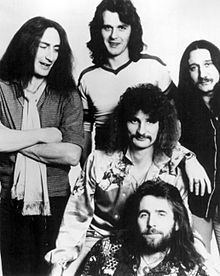
John Wetton (ex-Family and King Blood-red) joined the band in March 1975 and with him Return to Fantasy (June 1975) was recorded; representing a revitalised Uriah Heep, it soared upwardly to No. vii in the UK. "Information technology was a relief to have someone solid and reliable, and he had a load of ideas too," Box remembered.[19] The following "Year-long globe tour" (according to a headline in NME), was marred by a new blow. Mick Box fell off stage in Louisville, Kentucky on 2 August 1975, breaking the radial bone in his right arm (but he persevered through both the set and the tour, receiving three injections a night). On 26 March 1976 at Roy Wilkins Auditorium in St. Paul, Minnesota, John Wetton had an accident of his own when he (like his predecessor, Thain) received an electric shock on phase.[19]
In November 1975 The Best of Uriah Heep compilation was released, preceded by two solo albums: Byron'due south debut Take No Prisoners and Hensley's second, Eager to Please.
High and Mighty followed in June 1976. Information technology was considered lightweight; even Box stated: "less of the 'eavy and more of the 'umble" (making pointed reference to Uriah Heep'southward cocky-description every bit "'umble" in Dickens' David Copperfield).[19] The affair of product here became the point of major contention. With Bron committed to non-musical projects (including his air-taxi service) the band decided to produce the album themselves. The managing director afterwards insisted the result was Heep'due south worst album, while Hensley accused the manager of deliberately ignoring the ring's interests.[19] The album, though, was launched in the most lavish manner (with journalists and business people being flown off to the top of a Swiss mountain for a reception). However, it was non matched with the quality of live concerts, which were increasingly chaotic due to Byron's inconsistency on phase.[19] "He'd always got boozer later the show but it had never got to the point where it would jeopardize the evidence itself. The performance had always been first and foremost with David. Information technology was when the evidence started to come second that the bug began," Hensley remembered. "The altitude between David and the rest had grown to unworkable proportions," according to Blows. "It's a tragedy to say it just David was one of those classic people who could not confront upward to the fact that things were wrong and he looked for solace in a bottle," commented Bron. In July 1976, after the final show of a Spanish bout, Byron was sacked. Soon bassist John Wetton announced he was quitting. Obviously he was not comfy in the band, nor were his colleagues with him. Hensley after explained, "When he joined, we idea that we could replace a bang-up bass player (Thain) with some other slap-up bass actor, merely nosotros ignored the personality factor, which is crucial. It was similar grafting on a new slice of skin just information technology just didn't piece of work—the trunk rejected it."[nineteen]
Post-David Byron period (1977–1981) [edit]
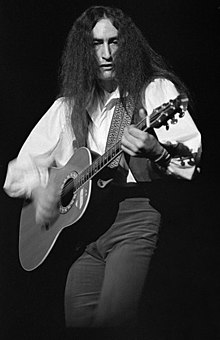
Uriah Heep recruited bassist Trevor Bolder (ex-David Bowie, Mick Ronson), and after having auditioned David Coverdale (Deep Majestic, Whitesnake), Ian Hunter and Gary Holton (Heavy Metallic Kids), brought in John Lawton, formerly of Lucifer'south Friend and the Les Humphries Singers, with whom they turned totally away from fantasy-oriented lyrics and multi-function compositions back towards a more straightforward difficult rock sound typical of the era. Box afterwards said, "Image-wise he wasn't quite what we were looking for, but his pipes were perfect and and so we went for the music stop of it." Hensley agreed: "He had a voice that I thought would requite a new dimension."
Firefly was released in February 1977, displaying "renewed effervescence and free energy in unveiling what was clearly a new beginning for Heep" (per. K. Blows), "a new vigour and confidence" (according to a Tape Mirror review)[20] and also the new singer'due south abilities: the latter (according to AllMusic), although lacking the multi-octave range of David Byron, "…boasted an impressive and emotionally rich difficult rock voice that instantly jelled with the Uriah Heep sound."[21] The band and so toured the US supporting Kiss. Paul Stanley subsequently recalled, "They were incredibly professional, and so consequent that their worst nights were fantabulous and their best were tremendous."[20]
Innocent Victim, released in November 1977, "had a slight edge on Firefly" according to Box, simply still in retrospect this "...blend of precipitous, short rockers and pop-friendly ballads" looked like "an attempt to courtroom the American AOR market."[22] The single "Free Me" (whose "acoustic mode and accent on harmonies brought the group dangerously close to Eagles territory," co-ordinate to AllMusic)[22] became an international hit. In Germany the album sold over a one thousand thousand copies and became Uriah Heep's most successful, which coincided with the success of the re-released "Lady in Black." For some fourth dimension during this flow, there were three Uriah Heep singles sitting together in the German Top twenty, these being "Wise Man" (from Firefly), "Lady in Black" and "Free Me".[20]
In the end of 1978, Fallen Angel came out, having completed a hat-trick of studio albums to feature a consistent lineup (only the 2nd time in their career that they had done and so). "As well poppy" for Mick Box's liking (but still, "too eccentric to fit the bill of an AOR record," co-ordinate to Allmusic),[23] it was well received at the time (Sounds gave it 4 stars) but failed to nautical chart. Meanwhile, the relative stability of the Lawton period belied the backside the scenes unrest having to do with Ken Hensley'due south earning much more than his colleagues. "Everything he wrote, he had to use… And if y'all insist in using everything yous end upwardly with substandard albums," disgruntled Box opined. The major rift, though, developed between Hensley and Lawton. As 1000. Blows writes, "the combination of constant friction between the two (resulting in the nearest thing to violence the group had seen) and the abiding presence of Lawton'southward wife on the road finally led to the vocalist getting the chop, soon after playing the Bilzen Festival in Belgium in August 1979."[20]
Ex-Lone Star John Sloman was brought in, a younger vocalizer who played keyboards and guitar and was, in the words of Box, "...an all rounder." But almost instantly, Lee Kerslake departed, after a row with Bron, whom the drummer accused of favouritism towards Hensley's material. Several tracks of the next album had to be re-recorded with a new drummer, Chris Slade (of the Manfred Isle of mann'due south Earth Band). Conquest LP was released in February 1980 (worldwide except the United States, where it was never released) and received 5 stars from Record Mirror, simply, according to Box, "was a hard anthology to tape" and represented "a dislocated Heep," even "a mess" (in the words of Trevor Bolder).[24] The band went on the 10th Ceremony Tour with Girlschool as support and attracted respectable crowds. Hensley was very unhappy, primarily with Sloman, and he explained why:
The ring had chosen John and I had opposed that decision. He was a practiced musician and he looked great but I thought he had little going for him vocally. The way that he interpreted songs were totally different to the way I had written them. I could understand wanting to move on but this was like the departure between Black Sabbath and Gino Vannelli. We weren't addressing our basic problems, in that we weren't re-establishing our musical direction and John definitely wasn't helping u.s. to do that.[24]
A meeting at the manager'due south role apropos the songwriting dissent was the concluding straw and, in September 1980, Hensley quit. Gregg Dechert, a Canadian who had worked with Sloman in Pulsar, came in and the band went on a 23-appointment tour of the Britain. After that Sloman left, citing musical differences for a reason.[25] He would later go on to work with UFO, Gary Moore and Robert Palmer. Hensley'southward acrimonious departure left the group in a state of collapse. Box and Bolder visited David Byron with bonny propositions. "We couldn't believe it when he said he didn't want to know," the guitarist remembered. Bolder, who by that time, "...had had plenty of Gerry Bron and the management," decided to join Wishbone Ash. When Dechert left, Uriah Heep were down to only Mick Box with the name and contract.[26]
Peter Goalby-era (1982–1986) [edit]
Box remembered, "I locked myself in my apartment for ii days and drank myself senseless in complete cocky-compassion. But I somehow managed to pull myself together and consider my options."[26] First he rang Lee Kerslake (who in the meanwhile had co-founded Blizzard of Ozz with Ozzy Osbourne) and the drummer brought along with him bassist Bob Daisley. Then John Sinclair came in whom Box knew from the times he was a member of Heavy Metal Kids and who currently played with a Los Angeles band called Lion. The band's new vocalist became Peter Goalby of Trapeze fame. The latter had once auditioned for Uriah Heep and failed, ironically Hensley beingness the simply band member who had supported him as a choice. "With us all contributing to the writing we forged our new direction," Box recalled.[26]
Produced by Ashley Howe, the Abominog album (according to Blows) was, "…important…in the manner it pulled Heep out of the Seventies and thrust them into the Eighties with conclusion muscle," even if sounded a flake also American.[27] Released in March 1982 (and preceded in Feb past the Abominog Junior EP), information technology won favour with the critics. Sounds gave it a five star review, the newly established stone magazine Kerrang! declared it "the nigh mature and perhaps best anthology of their career" and in retrospect it is still seen as "ane of the most consistent and engaging albums in the group's lengthy itemize."[28] The anthology did relatively well in the American charts (No. 56) after its US release in September 1982 and the ring successfully performed at the Castle Donington Monsters of Rock issue a few weeks prior to this, on 21 August.
Head Starting time (May 1983), produced once more by Ashley Howe (who, according to Goalby, became "similar the 6th fellow member of the band"),[27] followed much in the same vein, pursuing (according to AllMusic) "...a like combination of heavy metal firepower and AOR sleekness."[29] Not long before its release Daisley left the ring to return to Ozzy Osbourne and Trevor Bolder re-joined Uriah Heep.[27] Both albums, Abominog and Head Kickoff, updated the band's sound and generated a brief, newfound interest in Uriah Heep among younger heavy metal fans.
Uriah Heep toured the United states supporting Rush, Judas Priest and Def Leppard, whose vocaliser Joe Elliott remembered: "They were the best band that we've e'er toured with either as a headline or support, because there was no ego, no pretentious kind of stuff. They were good in as much that we learnt a lot from them."
By this fourth dimension Gerry Bron was Uriah Heep managing director no longer (they were looked after past Neil Warnock in Europe and Blue Oyster Cult's direction team in the US) and then, finally, Statuary Records collapsed nether the weight of debts, which, according to Box, "...toll Heep a lot of money."[xxx] Massive Asian and Southward American tours followed before the band returned to the studio with producer Tony Platt and a new bargain with CBS'due south Portrait label secured past new managing director Harry Maloney. Meanwhile, David Byron died of a middle attack and liver affliction on 28 February 1985 at the age of 38.[19]
Equator (March 1985) sold poorly, due to the fact that "CBS only did a terrible job getting it into the shops," equally Box saw it.[30] On the other mitt, what Kirk Blows described as "a solid piece of product that had the potential to practice extremely well" was regarded less favourably by later reviewers. Jason Anderson, for one, argues that with this "lackluster" anthology, high just "in high-schmaltz rating," the band squandered the chance that Portrait gave it.[31]
Totally exhausted and having serious voice bug, Goalby left in Nov 1985 after an Australian tour. "I loved and believed in Uriah Heep merely it kicked the shit out of me in the stop," were his parting words.[30] Then John Sinclair quit deciding to bring together Ozzy Osbourne and keyboardist Phil Lanzon (Grand Prix, Sad Café) came in to fit in immediately into the Box-envisaged scheme of things.[32]
American vocalist Steff Fontaine, formerly of Christian metal band Joshua, joined in July 1986 but he was criticised for being totally "unprofessional" (he missed, for some reason, a San Francisco gig) and was sacked in September 1986 after but 1 American tour.[33] Fontaine's position was offered and then to ex-1000 Prix, Praying Mantis and Stratus vocalizer Bernie Shaw, and that in retrospect was a winning move. Shaw "felt honoured at being invited to bring together such a legendary band" while for Box "information technology was like everything falling into place."[34]
New members, Raging Silence and Different World (1986–1993) [edit]

Bernie Shaw has been the singer of Uriah Heep since 1986.
The lineup remained unchanged from 1986 until 2007 with veteran Mick Box at the captain, Trevor Bolder on bass, Lee Kerslake on drums, vocalist Bernie Shaw and Phil Lanzon on keyboards. Their principal tour excursion has been in Germany, holland, Scandinavia, Japan and Russia. In December 1987 they became the first ever Western rock band to play in the Soviet Union, under Mikhail Gorbachev's policy of glasnost (Western pop acts Boney M, Cliff Richard, Nitty Gritty Dirt Band and Elton John had already played shows in that location in the late 70s during the pre-Gorbachev era).[35] At Moscow's Olympic Stadium the ring played ten consecutive nights to a total of 180,000 people (following a reception that Bernie Shaw remembered as being "something similar Beatlemania"), which was represented in the international press as not just an achievement for Uriah Heep just a major breakthrough for Western music in general.[32] The concerts were recorded and issued as the Live in Moscow album, which included three new tracks. Ironically, information technology was this behind the Iron Curtain excursion that did well to re-establish Heep'south name back at home. After a series of sell-out dates in Czechoslovakia, East Berlin and Bulgaria the band returned to United kingdom for the Reading Festival in Baronial 1988, and toured the UK with the Dogs D'Amour.
Raging Silence, produced by Richard Dodd and released in May 1989, was followed by a return to the Soviet Union, concerts in Poland, East Berlin, six dates in Brazil and another British tour. "The concluding ii years have been the most enjoyable of all my time in Heep," Trevor Bolder was quoted to say at the fourth dimension. The band played in the Central TV studios in Nottingham on 29 November 1989 (the pic was shown as part of the Contained TV series Bedrock and a few years later it was repeated in the Cue Music series) and historic its 20th Anniversary with a series of compilations and re-issues.[34]
Produced by Trevor Bolder and released early on in 1991, Dissimilar World got a mixed reception from the printing (put downwards in Kerrang!, hailed in Metallic Hammer) and sold poorly. "Yet another technically sound but artistically bland recording from Uriah Heep" (according to AllMusic)[36] failed to chart and marked the end of the band'southward contract with Legacy Records. Touring incessantly, the band issued some compilations of which Rarities from the Bronze Age and The Lansdowne Tapes (featuring previously unreleased material from the early 1970s) are considered most noteworthy. Still, the starting time half of the 1990s is regarded even past the Heep fans as "the wilderness years."[34]
Sea of Light and Sonic Origami (1994–2006) [edit]
In belatedly March/early on April 1995, the ring'southward erstwhile singer, John Lawton, briefly rejoined Uriah Heep for two weeks to tour South Africa and Austria with Deep Purple, filling in for Bernie Shaw, who was suffering from voice problems at the time.[32]
The Sea of Low-cal anthology (released in April 1995) produced by the band along with Kalle Trapp[37] was well received and in retrospect is seen equally the ring's return to form,[32] the key to success being (co-ordinate to critic Donald A. Guarisco) the manner it "forsook the ill-judged pop metal stylings of albums like Equator for a render to the gothic-tinged old-school metal fashion that highlighted classic Uriah Heep albums similar Look at Yourself.[38]
Produced by Pip Williams, Sonic Origami, originally issued in Europe and Japan in the fall of 1998, then, a year afterward, in the U.S., had "a one thousand, epic tone throughout" that, according to rock critic Steve Huey, "doesn't always lucifer Uriah Heep's journeyman-sounding prog-tinged hard rock, still being a solid entry in its chosen genre".[39] The release was followed past a successful European tour, which continued through 1999.[34]
The band released The Fable Continues DVD and so toured the UK. A reunion gig with Ken Hensley & John Lawton took place in London on vii December 2001 in the class of the Magicians Altogether Party, which since then became a tradition, fifty-fifty though Hensley never really joined again.
Before in 2001, during the summer, the group embarked on its first U.s. bout in seven years and returned the following year to headline both nights of Classic Stone Productions Classic Rock Festival at the Patriots Theater at the Trenton War Memorial in Trenton, New Jersey on v and 6 October 2002, aslope Mostly Autumn, Asia, Karnataka, Focus and Nektar. Uriah Heep played an electric testify the first dark and an all audio-visual show the 2d.
For most of the years that followed Uriah Heep take returned to Britain for a tour or just their almanac showcase concert, the Magicians Altogether Party, which in 2003 was held at the now demolished London Astoria.[34] All the while Mick Box acted as a manager for the band until, on v April 2005, they retained Simon Porter as their manager.[40]
Wake the Sleeper and Into the Wild (2007–2013) [edit]
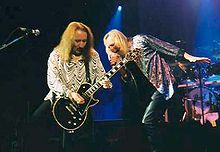
Mick Box and Bernie Shaw performing alive in London
In early 2007, drummer Lee Kerslake had to go out the group due to sick health. In March of that year the ring recruited Russell Gilbrook as their new drummer and immediately started recording a new studio anthology entitled Wake the Sleeper, where they used double drums in the songs Wake the Sleeper and War Child. Originally slated for a summer 2007 release, Universal Music finally released Wake the Sleeper on ii June 2008.
In October 2009 Uriah Heep released their 40th Anniversary anthology Celebration – 40 Years of Stone, containing new studio recordings of twelve of their best known tracks, plus two brand new songs.[41] "This collection underlines over again that Uriah Heep are deserving great respect for their past achievements but far more importantly it makes it crystal clear that this is a band with a bright future every bit well as a glorious history," wrote Chris Kee in his 9/x review in Powerplay magazine's Feb 2010 effect.[41]
A United States tour for June/July 2010 was delayed due to immigration problems; the kickoff two dates had to be rescheduled. This resulted in an appearance at B.B. King'southward in New York City every bit beingness the starting time date of the tour. And so Uriah Heep performed live on the Progressive Stone stage at the inaugural Loftier Voltage Festival in London's Victoria Park on 25 July 2010. They played their 1972 album Demons and Wizards in its entirety, beingness joined by ex-Whitesnake man Micky Moody on slide guitar.[42]
Uriah Heep released their 22nd studio album Into the Wild on 15 April 2011 in Europe (3 May in Due north America) via Frontiers Records.[43]
Bassist Trevor Bolder died on 21 May 2013 after suffering from pancreatic cancer. He was 62 years old.[44] British bassist John Jowitt (Ark, IQ, Loonshit) came in temporarily, followed by Dave Rimmer.
Outsider and Living the Dream (2013–2019) [edit]
In May 2013, when the band toured The Netherlands, Germany, Austria, Italy and Switzerland, they were again joined by their tardily 1970s era singer John Lawton who was covering for Bernie Shaw, who required time off for a routine medical procedure. Then both Bernie and John fronted the group for their show in San Javier, Espana on 12 July.
Uriah Heep entered the studio in January 2014[45] to begin recording their 23rd studio album Outsider, which was released in June 2014.[46] The album featured new bass actor Dave Rimmer who had been a substitute for Trevor Bolder the previous year.
In March 2015 they went on the "Down Unda Bout" visiting Sydney, Melbourne, Perth, Adelaide, Brisbane and Auckland. On 25 September, they announced the release of their greatest hits anthology Totally Driven, a collection of re-recordings of classic Heep songs made in 2001, which was released on 12 November. On 15 October that year, the grouping played aslope Ken Hensley and Lee Kerslake at a special two-hr concert at Crocus City Hall in Moscow.
Swedish singer Stefan Berggren, from Berggren Kerslake Ring (BKB), subbed for Bernie Shaw on lead vocals at the Rosenheim Festival in Frg on 14 July 2016 and once more later that aforementioned year for a New Year'southward Eve festival in Sibiu, Romania when Shaw had a family commitment.
2016 also saw the group play a few Japanese dates and the Legends Rock Cruise.
Former bass player John Wetton died on 31 January 2017 from colorectal cancer.
On 16 November 2017, it was reported that Uriah Heep would begin recording their 24th studio album, titled Living the Dream, with producer Jay Ruston.[47] The album was released on xiv September 2018, and the band was set to commence on a world tour in support of it that would accept them into 2019.[48]
Upcoming 25th studio album (2020–nowadays) [edit]
In a July 2020 interview with Sea of Tranquility, guitarist Mick Box and bassist Dave Rimmer confirmed that Uriah Heep were scheduled to brainstorm recording their 25th studio anthology in early 2021. When asked nigh a possible release engagement, Box said, "I recollect release is all down to the record visitor, I've gotta be honest. Nosotros never become a shout on that. They always seem to take some reason to release it at this time, that time, whatever fourth dimension."[49] In November 2021, Box revealed that the recording sessions of the new album were finished and "over in 50.A. now being mixed."[50]
Two former Uriah Heep members died in 2020: Lee Kerslake after a long cancer battle on September 19,[51] and Ken Hensley afterward a brusk illness on November 4.[52] They had both each recorded a solo album earlier that year, posthumously released in early 2021.[53] [54] Another quondam member of Uriah Heep, vocalist John Lawton, died on June 29, 2021 at the historic period of 74.[55]
Musical fashion and influence [edit]
Uriah Heep'due south music has predominantly been described by critics and journalists as progressive rock and heavy metal,[56] [57] [58] [59] [lx] [61] [62] with influences from acid rock, blues, and folk.[63] [64] Uriah Heep's distinctive features take always included a massive keyboard sound, strong song harmonies and (in the early years) David Byron'due south quasi-operatic vocals.[xvi] [65] In a 2018 interview, guitarist Mick Box cited "v-part vocal harmonies, Hammond organ and wah-wah guitar" every bit the master elements of the band's sound.[66]
Uriah Heep take been best-selling every bit an influence past numerous acts, including Iron Maiden,[67] Queen,[68] [69] Accept,[seventy] Ghost,[71] Fates Warning,[72] Sodom,[73] Death,[74] Dio, King Diamond, Krokus, Demons & Wizards (who were named later the band's album with the same name), Axel Rudi Pell and Fifth Affections.[75]
Personnel [edit]
Electric current members
- Mick Box – guitar, backing vocals (1969–present)
- Phil Lanzon – keyboards, co-lead vocals (1986–present)
- Bernie Shaw – lead vocals (1986–present)
- Russell Gilbrook – drums, percussion (2007–present)
- Dave Rimmer – bass, bankroll vocals (2013–present)
Discography [edit]
Studio albums
- ...Very 'Eavy ...Very 'Umble (1970)
- Salisbury (1971)
- Look at Yourself (1971)
- Demons and Wizards (1972)
- The Magician's Birthday (1972)
- Sweet Liberty (1973)
- Wonderworld (1974)
- Render to Fantasy (1975)
- Loftier and Mighty (1976)
- Firefly (1977)
- Innocent Victim (1977)
- Fallen Angel (1978)
- Conquest (1980)
- Abominog (1982)
- Head Starting time (1983)
- Equator (1985)
- Raging Silence (1989)
- Different World (1991)
- Bounding main of Light (1995)
- Sonic Origami (1998)
- Wake the Sleeper (2008)
- Into the Wild (2011)
- Outsider (2014)
- Living the Dream (2018)
References [edit]
- ^ "Quondam URIAH HEEP Keyboardist KEN HENSLEY's Final Album To Receive Posthumous Release In March". Blabbermouth.net. 25 Baronial 2020. Retrieved 24 March 2021.
- ^ "Uriah Heep eager to evidence Okanagan fans they've still got it". Kelowna At present. ix June 2019. Retrieved 5 June 2021.
- ^ "Uriah Heep | Official site of band". uriah-heep.com. Retrieved 3 February 2017.
- ^ a b "Uriah Heep Billboard 200". AllMusic . Retrieved 8 April 2010.
- ^ "LADY IN Black – THE NEW Single BY URIAH HEEP". Uriah Heep – Official Web Site. Retrieved two January 2010.
- ^ Uriah Heep. Singles. musicline.de.
- ^ a b c Kirk Blows. "Uriah Heep Story". www.uriah-heep.com. Retrieved fifteen March 2007.
- ^ "Uriah Heep". www.classicbands.com. Retrieved 6 September 2009.
- ^ Kirk Blows. "Uriah Heep Story p.two". www.uriah-heep.com. Retrieved 15 March 2011.
- ^ Stephen Thomas Erlewine. "Uriah Heep biography". AllMusic . Retrieved one January 2011.
- ^ a b Donald A. Guarisco. "Salisbury album review". AllMusic . Retrieved 1 January 2011.
- ^ Kirk Blows. "Uriah Heep Story p.iii". www.uriah-heep.com. Retrieved 15 March 2011.
- ^ a b c d Kirk Blows. "Uriah Heep Story p.four". www.uriah-heep.com. Retrieved 15 March 2011.
- ^ Stump, Paul (1997). The Music'south All that Matters: A History of Progressive Rock. Quartet Books Express. p. 81. ISBN0-7043-8036-half-dozen.
- ^ a b c d east f thousand Kirk Blows. "Uriah Heep Story p.5". www.uriah-heep.com. Retrieved 15 March 2011.
- ^ a b c Guinness Encyclopedia of Popular Music (1994). "Uriah Heep biography". www.enotes.com. Retrieved 8 Apr 2010.
- ^ Donald A. Guarisco. "Demons and Wizards album review". AllMusic . Retrieved 1 Jan 2011.
- ^ Donald A. Guarisco. "Sugariness Liberty review". AllMusic . Retrieved 1 Jan 2011.
- ^ a b c d eastward f g Kirk Blows. "Uriah Heep Story p.6". www.uriah-heep.com. Retrieved 15 March 2011.
- ^ a b c d Kirk Blows. "Uriah Heep Story p.7". Uriah-heep.com . Retrieved fifteen March 2011.
- ^ Donald A. Guarisco. "Firefly anthology review". AllMusic . Retrieved i Jan 2011.
- ^ a b Donald A. Garrusco. "Innocent Victim album review". AllMusic . Retrieved i January 2011.
- ^ Donald A. Garrusco. "Fallen Affections album review". AllMusic . Retrieved ane Jan 2011.
- ^ a b Kirk Blows. "Uriah Heep Story p.8". world wide web.uriah-heep.com. Retrieved 15 March 2011.
- ^ Kirk Blows. "Uriah Heep Story p.9". www.uriah-heep.com. Retrieved 15 March 2011.
- ^ a b c Kirk Blows. "Uriah Heep Story p.10". world wide web.uriah-heep.com. Retrieved 15 March 2011.
- ^ a b c Kirk Blows. "Uriah Heep Story p.11". www.uriah-heep.com. Retrieved 15 March 2011.
- ^ Donald A. Guarisco. "Abominog review". AllMusic . Retrieved 1 Jan 2011.
- ^ Donald A. Guarisco. "Head First review". AllMusic . Retrieved 1 January 2011.
- ^ a b c Kirk Blows. "Uriah Heep Story p.12". www.uriah-heep.com. Retrieved 15 March 2011.
- ^ Jason Anderson. "Equator review". AllMusic . Retrieved 1 January 2011.
- ^ a b c d Colin Larkin, ed. (1997). The Virgin Encyclopedia of Popular Music (Concise ed.). Virgin Books. pp. 125/6. ISBNi-85227-745-9.
- ^ Kirk Blows. "Uriah Heep Story p.13". www.uriah-heep.com. Retrieved xv March 2011.
- ^ a b c d eastward Kirk Blows. "Uriah Heep Story p.14". world wide web.uriah-heep.com. Retrieved 15 March 2011.
- ^ "Uriah Heep". Uriah Heep. Retrieved 4 July 2011.
- ^ Jason Anderson. "Different World". AllMusic . Retrieved 1 January 2011.
- ^ Bounding main of Light anthology credits. – AllMusic
- ^ Donald A. Guarisco. "Sea of Light review". AllMusic . Retrieved 1 January 2011.
- ^ Steve Huey. "Sonic Origami review". AllMusic . Retrieved ane January 2011.
- ^ "Uriah Heep". Uriah Heep. 5 April 2005. Retrieved 4 July 2011.
- ^ a b "Into the Wild". world wide web.workhardpr.com. Retrieved 1 Jan 2011.
- ^ High Voltage Day Ii. The residual of the bill reviewed. www.classicrockmagazine.com
- ^ "BLABBERMOUTH.NET – URIAH HEEP: New Album Artwork, Track Listing, Release Date Revealed". Roadrunnerrecords.com. Archived from the original on 3 March 2011. Retrieved 4 July 2011.
- ^ "Trevor Bolder, bass role player for David Bowie's 70s backing ring, dies aged 62". The Guardian. 21 May 2013.
- ^ "Uriah Heep To Enter Studio In January". Blabbermouth.internet. 15 December 2013. Retrieved 15 December 2013.
- ^ "Uriah Heep To Release New Album 'Outsider' In June". Blabbermouth.net. 28 March 2014. Retrieved 28 March 2014.
- ^ "Uriah Heep To Enter Studio With Producer Jay Ruston". Blabbermouth.internet. sixteen Nov 2017. Retrieved 17 Nov 2017.
- ^ "URIAH HEEP: 'Living The Dream" Anthology Details Revealed; 'Grazed By Heaven' Video Released". Blabbermouth.net. 5 June 2018. Retrieved 8 June 2018.
- ^ "URIAH HEEP To Record New Album In February". Blabbermouth.cyberspace. ane August 2020. Retrieved 1 August 2020.
- ^ "URIAH HEEP Completes Recording New Album: 'We're Very Happy With It'". Blabbermouth.net. 3 Nov 2021. Retrieved 4 Nov 2021.
- ^ Fraser Lewry (xix September 2020). "Uriah Heep and Ozzy Osbourne drummer Lee Kerslake dead at 73". Louder Audio . Retrieved nine November 2020.
- ^ "Erstwhile URIAH HEEP Keyboardist KEN HENSLEY Dead At 75". Blabbermouth.cyberspace. 5 November 2020. Retrieved nine November 2020.
- ^ "Tardily OZZY OSBOURNE And URIAH HEEP Drummer LEE KERSLAKE's Debut Solo Album 'Eleventeen' Receives Posthumous Release". Blabbermouth.net. 26 Feb 2021. Retrieved 5 March 2021.
- ^ "Sometime URIAH HEEP Keyboardist KEN HENSLEY's Concluding Album To Receive Posthumous Release In March". Blabbermouth.internet. 9 December 2020. Retrieved 9 Dec 2020.
- ^ "Former URIAH HEEP Singer JOHN LAWTON Dead At 74". Blabbermouth.cyberspace. five July 2021. Retrieved half dozen July 2021.
- ^ Weinstein, D. (2009). Heavy Metal: The Music And Its Civilisation. Perseus Books Group. p. 17. ISBN9780786751037 . Retrieved 3 February 2017.
- ^ "CMJ New Music Monthly". CMJ New Music. CMJ Network, Inc.: 98 August 2001. ISSN 1074-6978. Retrieved 3 February 2017.
- ^ Munro, J.N. (2011). The Sensational Alex Harvey. Birlinn. ISBN9780857901521 . Retrieved 3 February 2017.
- ^ Hayward, K. (2013). Tin Pan Alley: The Ascension of Elton John. Soundcheck Books. ISBN9780957144200 . Retrieved 3 February 2017.
- ^ Case, G. (2011). Led Zeppelin FAQ: All That's Left to Know About the Greatest Hard Rock Band of All Time. Backbeat Books. ISBN9781617130717 . Retrieved 3 February 2017.
- ^ Hecker, P.; Hawkins, P.S.; Burns, P.L. (2012). Turkish Metal: Music, Meaning, and Morality in a Muslim Society. Ashgate Publishing Express. ISBN9781409456575 . Retrieved three February 2017.
- ^ Talevski, N. (2010). Rock Obituaries - Knocking On Sky'southward Door. Autobus. p. 644. ISBN9780857121172 . Retrieved 3 February 2017.
- ^ "Uriah Heep | Biography & History | AllMusic". AllMusic . Retrieved 3 February 2017.
- ^ Metzer, M. (2008). Rock Band Proper noun Origins: The Stories of 240 Groups and Performers. McFarland, Incorporated Publishers. p. 207. ISBN9780786455317 . Retrieved 3 February 2017.
- ^ Stephen Thomas Erlewine. "Uriah Heep biography". AllMusic . Retrieved viii Apr 2010.
- ^ Aledort, Andy (28 November 2018). "Mick Box Talks Uriah Heep's New Album, 'Living the Dream'". Guitar World. Hereafter plc. Retrieved ten Nov 2020.
- ^ "Live Review: Uriah Heep in Serbia - How Practice You Make Magic?". Hardwired Mag. half-dozen Feb 2019. Retrieved 24 March 2021.
- ^ "Uriah Heep: Even so 'Living the Dream' every bit the 'Embankment Boys of Heavy Metal,' Touring with Judas Priest (Mick Box Q&A)". Rock Cellar Mag. Retrieved 24 March 2021.
- ^ "Tobias Forge says Uriah Heep is a big influence to Ghost". Rock and Roll Garage. May 2019. Retrieved 24 March 2021.
- ^ "Have Family Tree — The Metal". givememetal.com . Retrieved 30 August 2021.
- ^ "Uriah Heep'due south 50 Years In Rock released on 30th October 2020 on BMG". All Well-nigh The Rock. 26 December 2019. Retrieved 24 March 2021.
- ^ "Fates Warning Family Tree — The Metal". givememetal.com . Retrieved 30 August 2021.
- ^ "Sodom Family Tree — The Metallic". givememetal.com . Retrieved 30 Baronial 2021.
- ^ "Death Family Tree — The Metal". givememetal.com . Retrieved thirty August 2021.
- ^ "Uriah Heep's Fifty Years In Stone released on 30th Oct 2020 on BMG". All About the Rock. 26 August 2020. Retrieved 24 March 2021.
External links [edit]
 | Wikimedia Eatables has media related to Uriah Heep. |
- Official website
- Uriah Heep discography at MusicBrainz
- Uriah Heep discography at Discogs
- Uriah Heep at MusicMight
Source: https://en.wikipedia.org/wiki/Uriah_Heep_%28band%29
Posted by: helsleybeenter.blogspot.com
0 Response to "Who Is The Guy With "Eye Makeup" In The Uriah Heep Video"
Post a Comment