

How To Make A Draw Shave
Click on any moving picture to see a larger version.
Of all the paw tools, I recall the drawknife can exist the near intimidating - especially if you lot've never picked i upwardly earlier. There'southward something about the simplicity of the tool that makes it appear so challenging. It's just a blade with ii handles. In that location are no added controls, adjustments, knobs, buttons, batteries or lasers – it's just the bract and your skill that make it work.
The uncomplicated, unguarded blade ways that you can take a thin shaving, or a deep cut, depending on your preference. You lot command the size of the cut – it'due south not determined by settings on the tool.
Wood choice makes a huge departure in the quality of the cut. Straight grain woods is the easiest and all-time. The knife naturally wants to follow the grain. The blade tin dig into the wood when the grain runs out (though skewing a sharp knife does improve a cut that is working against the grain). Direct grain oaks and ash - ring porous woods - are preferable, as they cut hands and predictably.
The drawknife'due south partner is the shave horse. You want to get i. Or at least borrow one – my approximate is that you'll never get back to using a workbench or modified setup once yous spend a niggling fourth dimension using 1. You'll find them on Craigslist or yous tin rapidly brand 1. The shave horse puts the piece of work piece right above your lap and makes adjustment easy. I'm always excited when a project puts me at the shave equus caballus.
Trying to explicate all the drawknife uses and approaches and techniques is a trivial like writing near how to ride a wheel. There is so much intuition and experience in the procedure that technical writing just doesn't capture it. Then I'thou going to forgo that approach to provide tips and suggestions. The best matter you tin can do is get started.
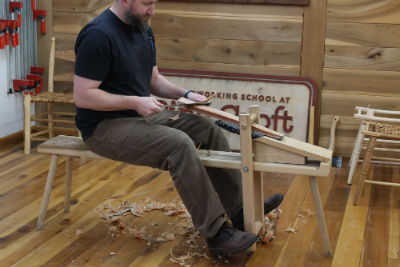
Just where should y'all begin when considering the drawknife? My basic advice: just go one. Which 1 to obtain? I don't know – they all work (as long equally the blade isn't also pitted with rust and it looks to be in good status). I use a direct x" bract. It's the first ane I got my hands on. I grew comfortable using and tuning it, and now information technology's the one I always take hold of. Others don't experience "every bit right" when I use them. I would guess it'll be the aforementioned experience for you – you'll get attuned to the one you take. I will mention this: straight blades are a little easier to sharpen, relative to the curved blade knives.
I'd recommend going into a store to agree and handle the tool before purchasing one. They all feel a little unlike. A x" blade may be to also large or heavy for you lot. The viii" bract may be right. 8" and x" are the near common, and more versatile for furniture related work. There are larger or smaller ones, but those typically have a more specialized use. (One instance of this: large drawknives that are made and used to de-bark a tree.) One make may feel more comfortable to you than other. Yous'll just know afterwards handling them and trying different models. In that mode they're similar manus planes – some people prefer the #iii bench airplane, others swear by the #4-one/two. And just like any other cutting manus tool, the drawknife is at its best when the blade is razor precipitous.
Which leads usa to sharpening – anybody's favorite bailiwick. You lot'll demand to grow comfortable sharpening the drawknife because it'due south going to eventually dull. My recommendation as you get started for the first fourth dimension: hollow grind it like y'all would a chisel or a aeroplane iron. There are other approaches. Diving deeply into sharpening is a trivial much for this post, just there are corking sharpening resources out there. I've added a few trusted sources at the end of this mail. Find a method you like and go for it.
Ane sharpening tip: when holding the drawknife to hone, always hold the tool so the blade is away from your chest.
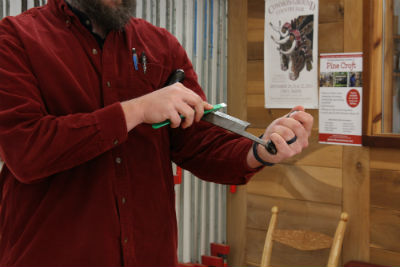
Then e'er push to the sharpening rock or strop. Go into this habit; it'southward a way to minimize the adventure of unnecessary blood.
A precipitous tool helps immensely when sitting upon the shave horse. Information technology's easier to piece through the material with that freshly sharpened pocketknife. Become it sharp and keep it that way by honing and tuning it between uses. Information technology should be a rare occasion that it needs to render to the grinder.
Wet woods (wood from a freshly cut tree or log) is easier to shave, though you tin piece through harder wood. Outset bespeak of advice when shaving – take small-scale shavings until y'all are comfy with the tool. You lot should be able to accept a long, controlled, shine pull with the tool – non a curt or halting cutting. There'south a rhythm to it. You'll proceed your elbows close to your sides and rock your trunk back slightly equally you work (It'southward not nearly as exaggerated as this, only imagine rowing an oar – information technology's non all arm work!). Making the cutting should feel pretty easy, done without much try. If you detect it hard to pull the tool and then you are probably trying to take likewise much material. Endeavor a lighter shaving. You're pulling the precipitous blade towards your body – always brand sure you're under control. Taking smaller shavings helps with this.
Does your knife cutting bevel-upward or bevel-down? That's really the wrong question to ask. It will cut either mode – bevel-upward or bevel-down – though 1 way may be best. It is probably easier and more than comfortable to use the knife one fashion compared to the other. Observe how your wrists feel while using the drawknife. They should be straight while the tool cuts. This is more natural, comfy and piece of cake. While it's possible to cut with the tool upside-down, you volition become physically fatigued and discouraged with the results. I've included a couple of images: one showing the knife cutting comfortably with the bevel downward. In the other image I need to kink my wrists to make the tool cut – information technology's uncomfortable and not at all natural. My knife is ever used bevel-down.
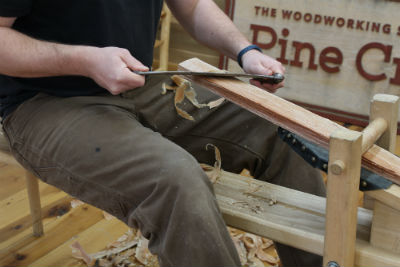
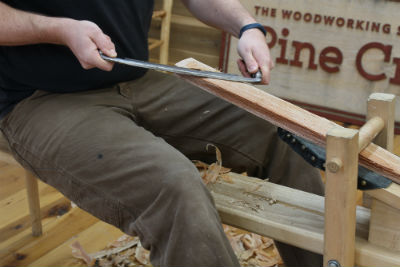
Skew the tool so that it slices. Take your dominant hand lead and piece beyond the full length of the blade as you pull the cut through the wood. I'1000 right hand dominant, and then my cut begins on the right side of the blade, nearest my right paw, and the cut moves across the blade equally I pull towards my abaft, left hand. Observe the cut starting on 1 side of the blade and finishing on the other.
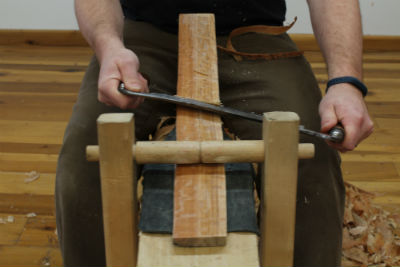
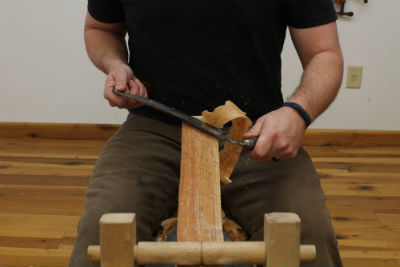
You lot'll get a amend cut by slicing and the blade will wear evenly and last longer than simply cut in the middle each pass.
Basic describe pocketknife skills are apace attainable. You demand to get a sharp knife, get a small amount of fresh wood and spend 20 minutes on the shave equus caballus. Similar the bicycle, information technology'll be awkward until information technology "feels" correct. Then y'all've got it.
Here are a few of my trusted sources on the draw knife. They've written deeply on shave horse design, draw pocketknife sharpening and use, and green woodworking.
View the dissimilar options for Drawknives available at Highland Woodworking past clicking here.

Source: https://www.highlandwoodworking.com/handtools/the-drawknife-hand-tool.html
Posted by: helsleybeenter.blogspot.com
0 Response to "How To Make A Draw Shave"
Post a Comment